Find Lawyers, Law Firms and other Law Service Providers in your region. Or submit a provider to our directory.
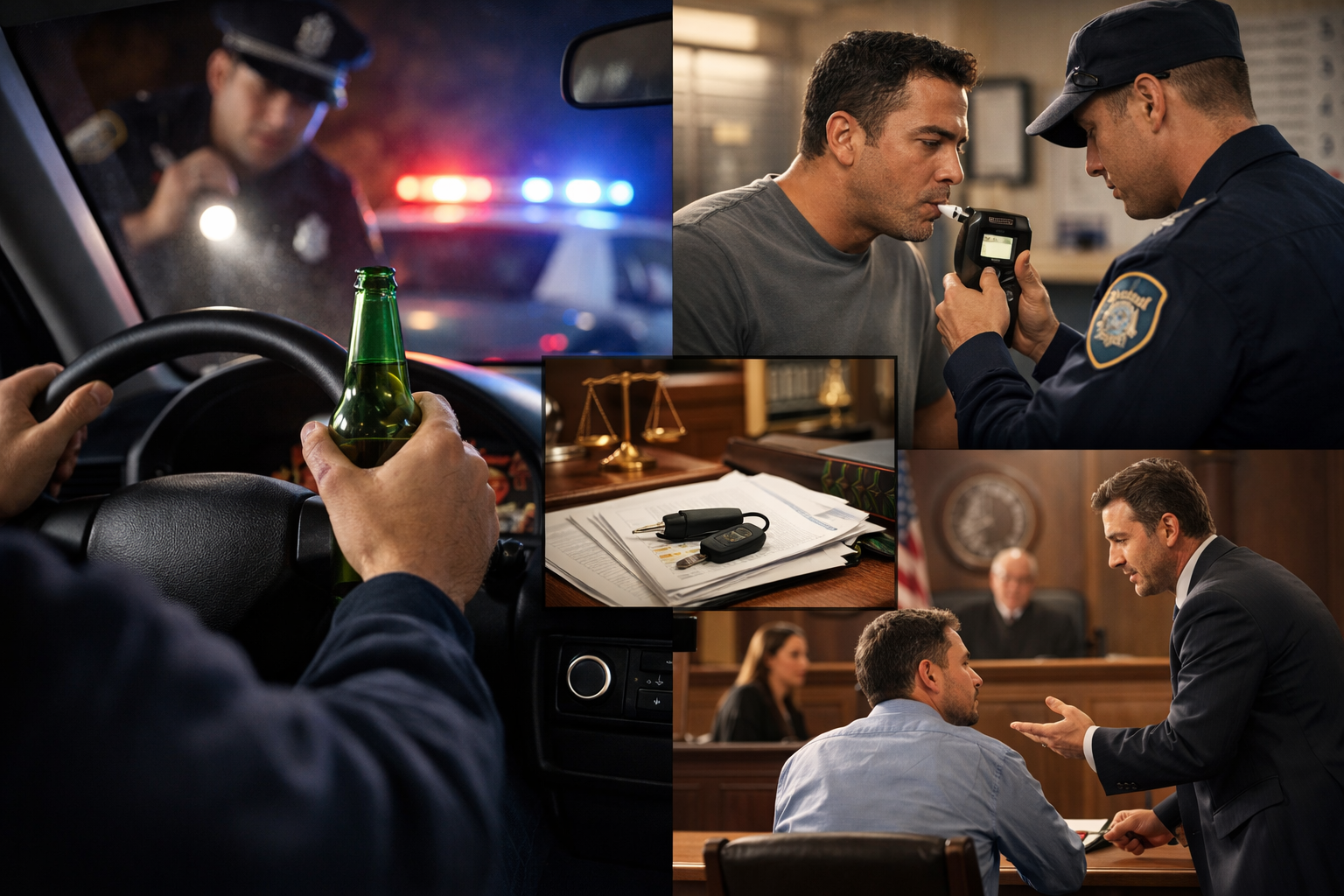
“Drunk driving defense” refers to the legal strategies used to challenge a DUI/DWI charge (driving under the influence/driving while intoxicated). A defense is not limited to arguing that a driver had no alcohol or drugs in their system. It can also involve contesting whether law enforcement had a lawful basis to stop the vehicle, whether field sobriety or chemical tests were administered correctly, whether the results are scientifically reliable, and whether the prosecution can prove each element of the offense beyond a reasonable doubt.
Because DUI laws vary by state and cases turn on specific facts, effective defense work is typically a careful, document-driven analysis of the entire timeline: the stop, roadside investigation, arrest decision, chemical testing, and any administrative driver’s license action.
Police must generally have reasonable suspicion of a traffic violation or criminal activity to initiate a stop. A defense may focus on whether the cited reason (weaving, speeding, equipment issue, failure to signal) is supported by dashcam video, bodycam footage, or objective facts. If the stop lacks legal justification, a court may suppress evidence obtained afterward, which can seriously weaken the case.
Even if the stop is valid, officers must not unreasonably prolong it. A defense may argue that the officer extended the stop without adequate grounds before beginning DUI-related questioning or testing. Courts often look closely at timing: when observations were made, when questions began, and whether the officer had sufficient indicators to expand the stop into an impaired-driving investigation.
Standardized field sobriety tests (often including the walk-and-turn, one-leg stand, and horizontal gaze nystagmus) are frequently presented as proof of impairment. However, their accuracy depends on proper instructions, appropriate conditions, and correct scoring. A defense may scrutinize:
Many jurisdictions use handheld roadside breath devices as a preliminary screening tool. Defense analysis may address device calibration, operator training, and whether the PBT is admissible for proving a specific alcohol concentration. Even when not admissible at trial, it may have influenced the arrest decision, which can become a point of litigation.
Breath tests can be contested on scientific and procedural grounds. Possible issues include improper calibration and maintenance, radio frequency interference (depending on the device), inadequate observation periods before testing, and mouth alcohol contamination (from burping, reflux, or recent dental work). A defense may request maintenance logs, solution change records, and operator certification to verify compliance with required protocols.
Blood testing is often viewed as more precise, yet it presents its own vulnerabilities. Defense counsel may examine whether the draw was performed by a qualified person, whether the sample was properly sealed and labeled, and whether preservatives and anticoagulants were used correctly. Chain of custody is critical: gaps in documentation or unexplained transfers can raise doubts about contamination, mislabeling, or tampering.
Additionally, blood results may be affected by storage temperature, degradation over time, or lab backlogs. An independent retest by a defense-selected laboratory may be possible in some cases, particularly when the sample has been preserved.
Drug-related DUI cases often involve complex questions. Unlike alcohol, many drugs do not correlate neatly between concentration and impairment. A defense may explore whether the observed driving and behavior align with the alleged substance, whether prescribed medications were taken as directed, and whether the state can prove impairment at the time of driving rather than mere presence of metabolites.
DUI cases often raise Fourth Amendment (or state constitutional) questions: Was there probable cause to arrest? Was a blood draw conducted with valid consent, a proper warrant, or under a recognized exception? If evidence was obtained unlawfully, suppression motions can limit what the prosecution may present at trial.
Defendants frequently make statements during roadside questioning or after arrest. A defense may evaluate whether questioning was custodial and whether Miranda warnings were required. Even when statements are admissible, they may be challenged as unreliable due to stress, confusion, language barriers, or leading questions.
Many people are surprised to learn that a DUI arrest can trigger an administrative driver’s license suspension separate from the criminal case. These proceedings often have strict deadlines to request a hearing. Winning an administrative hearing does not always dismiss the criminal charge (and vice versa), but testimony and evidence from one process can affect the other. A coordinated strategy considers both tracks from the start.
Not all defenses aim for a full acquittal. Sometimes the strongest result is minimizing consequences through reduced charges, sentencing alternatives, or amended allegations (for example, challenging an enhancement based on prior convictions or high-test results). Negotiation leverage often comes from documented weaknesses in the stop, testing, or proof of impairment.
Some jurisdictions offer diversion, deferred adjudication, or treatment courts, particularly for first-time offenders. Eligibility rules can be strict and may exclude cases with accidents, injuries, or very high alcohol concentrations. A defense attorney can help evaluate whether the long-term benefits (such as avoiding a conviction) outweigh the program requirements.
At trial, drunk driving defense often turns on credibility and science. Video evidence, inconsistencies in reports, and cross-examination of the arresting officer are central. In technical cases, expert witnesses may address breath device limitations, blood lab procedures, pharmacology, and the relationship between test results and actual impairment.
If you have been arrested or charged, the most practical steps are to preserve evidence and act quickly. Request copies of the police report, citation, and any notice about license suspension deadlines. Write down your recollection while it is fresh, including where you were, what you ate, medications taken, and the timing of drinks (if any). If video exists (dashcam, bodycam, surveillance), early requests can be crucial before footage is overwritten.
Drunk driving defense is highly fact-specific, and outcomes depend on local law, the judge, the evidence, and prior history. A well-prepared defense focuses on both law and science: testing whether the state’s case is legally obtained, procedurally sound, and scientifically reliable.